
However, millions of patients can now see clearly after cataract surgery
Discover more about this condition and how to treat it
- Cataracts are a very common condition of the eye, caused by the lens in your eye turning cloudy.
- Cataracts typically develop slowly over time and affect people over the age of 50.
- Occasionally infants can have congenital cataracts.
A cataract is a clouding of the lens in your eye, which causes blurred vision.
If you’ve been diagnosed with cataracts, or you suspect you may have a cataract, there’s no need to worry. They are very common and occur naturally with age. They are also very easily treated.
The symptoms
A cataract is not a visible film on the outside of the eye. You may not even be aware that it is developing, as they usually develop over time.
Common symptoms include:
- Deterioration of your distance and reading vision
- Hazy, fuzzy, blurred or double vision
- Increased sensitivity to light and glare
- Difficulty driving at night
- Little improvement in vision, even with stronger glasses
Cataracts occur naturally due to the ageing of the eye, and diagnosis in adults over 40 is quite normal. They can also sometimes occur in infants and children as a congenital defect.
Normally, the lens at the front of the eye focuses light onto the retina at the back of the eye, creating a sharp image. When the lens becomes cloudy, the light can’t pass through freely, which is why your vision becomes blurred.
Contrary to popular belief, cataracts are not caused by overuse of the eyes, nor can they be made worse by using the eyes.
Compare the two images below:
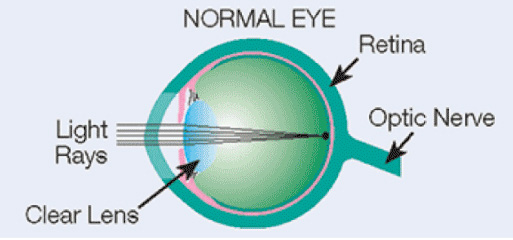
As a cataract forms, the lens becomes opaque and light cannot easily be transmitted to the retina.
Our ophthalmologist can easily assess and diagnose cataracts.
We use eye drops to dilate the pupils and then use an instrument called a slit lamp which provides lighting and magnification to detect the eye’s lens where cataracts develop.
Fortunately, cataract operations are now faster and safer than ever.
Thanks to the pioneering no-stitch surgical techniques we use at Eye Institute, there’s no need to stay overnight in the hospital. In fact, you could be home within an hour of your cataract surgery.
Not all cataracts require treatment, but if your vision is affected to the point where it interferes with your work or lifestyle, you should consider surgery. It makes a huge difference.
Will I be awake during surgery?
Yes. We perform cataract surgery using either local or topical anaesthetic only.
Does cataract surgery hurt?
There is little to no pain during cataract surgery. We will anaesthetise the eye using local anaesthetic or anaesthetic drops.
When are cataracts bad enough to get cataract surgery?
If you are struggling with blurred vision or experiencing bothersome vision problems such as glare and halos, it may be time to discuss your treatment options with an eye specialist.
Choose the option below that sounds most like you to discover your best solution
Give us a call to understand how your insurance can help cover your treatment



Cataract treatment options can be confusing. We’ve made the journey as straightforward as can be



Get a quick overview of everything you need to know about gaining visual freedom

Can you reverse cataracts without surgery?
What's a cataract and can you reverse cataracts without surgery? In this post, Dr Adam Watson explains how cataracts develop and the options available.

What causes cataracts?
Cataracts are described as the clouding of the lens in the eye. Whilst it is often age-related, there are a few other causes that you should be aware of. In this short video, Dr Adam Watson tells you all you need to know about cataracts and their causes…
Reducing the cost of cataract surgery
Reducing the cost of cataract surgery. With a [...]
Learn more about refractive cataract surgery from authoritative sources.
Note: These links will take you off our website